Wecelium
A Postgres-native architecture system for AI-assisted engineering using vector search, graph traversal, and full-text search fusion.

Wecelium Logo
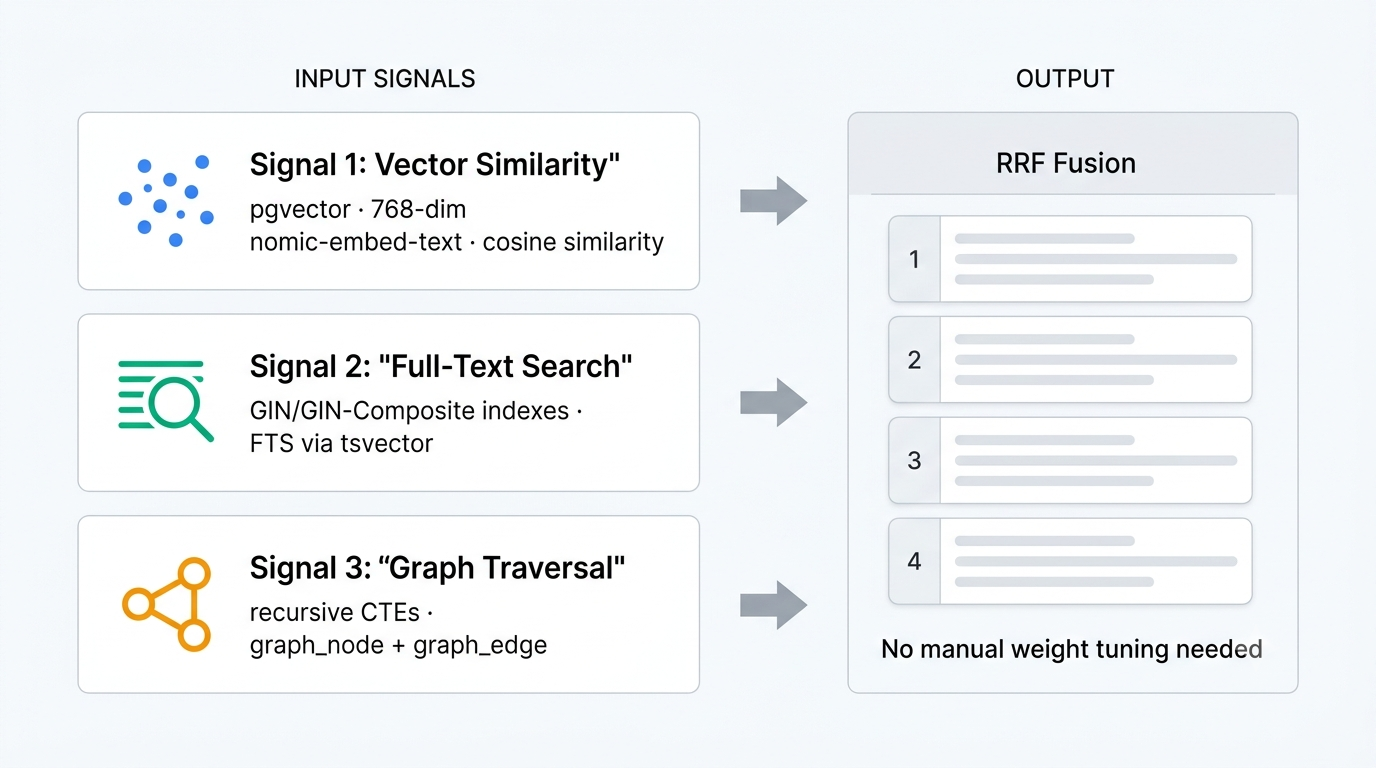
Three-signal Reciprocal Rank Fusion: vector similarity, full-text search, and graph traversal fused without manual weight tuning
Technologies Used
database
tool
framework
Challenges
Designing a knowledge schema that captures architectural decisions, trade-offs, and code insights as structured data rather than text. Implementing three-signal RRF without manual weight tuning — combining vector similarity (pgvector 768-dim), full-text search (GIN indexes), and graph traversal (recursive CTEs) in parallel and fusing results. Building a staging confirm gate for human-in-the-loop knowledge ingestion. Managing a pending-review queue with session hooks. Schema design that supports reversibility via additive migrations (Sqitch deploy/revert/verify). MCP tools for knowledge interaction (30+ tools). Progressive context loading via session lifecycle hooks. Pitching the business case to decision-makers and presenting the engineering rationale.
Key Learnings
Three-signal Reciprocal Rank Fusion for search — compensating for blind spots of each retrieval signal. PostgreSQL as a knowledge graph: recursive CTEs, GIN indexes, pgvector, and JSONB for extensible metadata. Schema design where methodology is embodied in table structure (personas/problems as rows + join tables). Session lifecycle hooks for capturing knowledge organically during work. MCP tool architecture for structured knowledge interaction. Progressive context loading — delivering relevant knowledge at point-of-action, not upfront. Conway's Law as design principle for knowledge system architecture. Business case presentation and technical pitching.
Project Details
Related Projects

YouTube Transcript Search
Full-stack application with browser extensions for capturing and searching YouTube video transcripts across channels.

Contengine
A distributed orchestration gateway for local LLM inference servers with JWT auth, rate limiting, and isolated MCP tool containers.